Can a tow truck refuse to take my car in Phoenix?
Yes, but only in specific situations, and which rules apply depends entirely on who ordered the tow. Here is when an operator can refuse, and what you are owed either way.
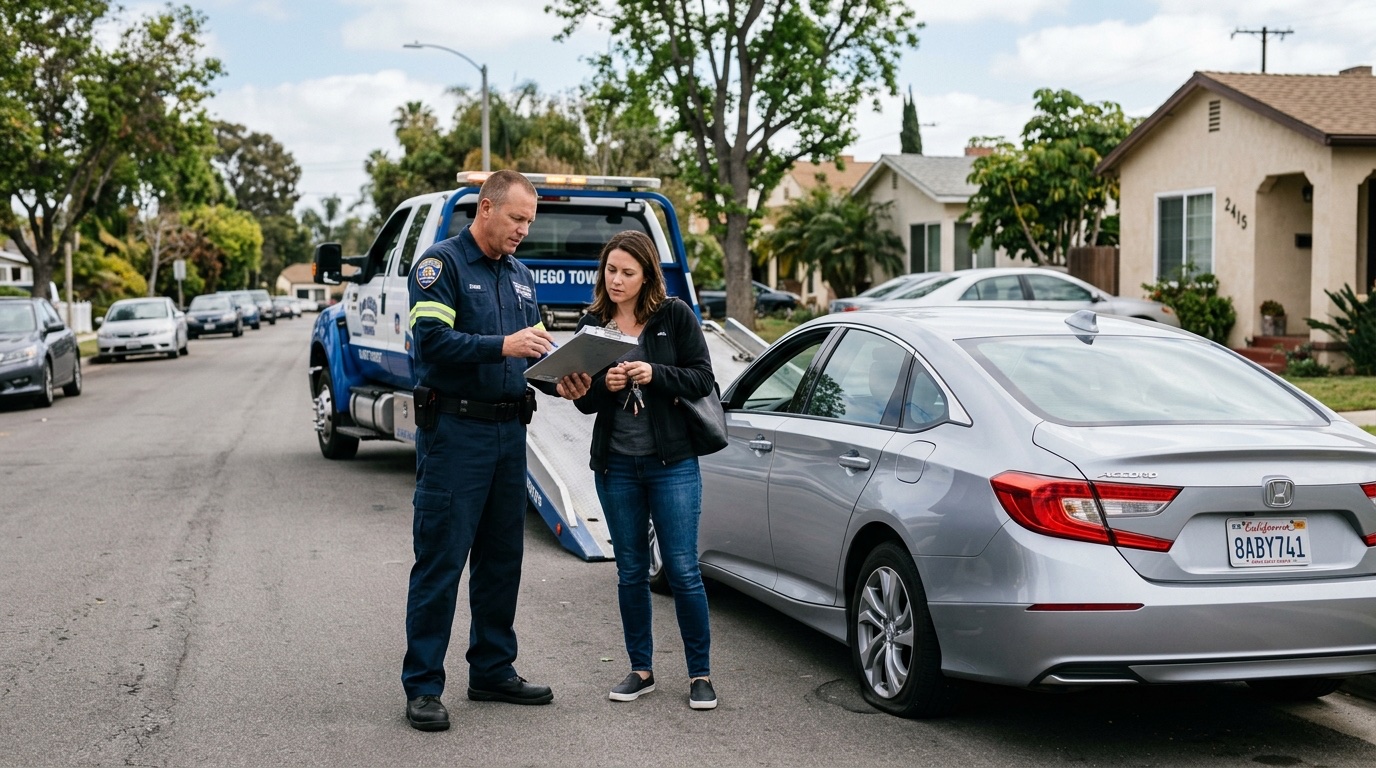
What you'll learn
- The legitimate reasons a metro Phoenix tow operator can refuse a job
- The difference between a tow you order and one the police or a property owner orders, and why your choice of company only applies to one of them
- What ARS 9-499.05 and Phoenix City Code 36-6 require of a private-property tower, and what they forbid
- Your rights as the vehicle owner if you are refused
- What changes when the breakdown happens on a police-ordered 20-day impound
Step by step
- Reason 1 - Vehicle weight or size exceeds the truck's rated capacity, for example a standard wheel-lift truck sent to a loaded box truck or bus that needs a heavy-duty rig.
- Reason 2 - Vehicle is unsafe to tow: a hazardous fluid leak, a fire risk, or structural collapse.
- Reason 3 - The operator cannot verify ownership, with no registration and no clear vehicle-to-driver match.
- Reason 4 - The location is unsafe for the operator: an active hostile environment, no safe pull-off, a live work zone, or a freeway spot with no usable shoulder.
- Reason 5 - The operator does not service that area or that vehicle type, for example an electric vehicle call to an operator with no flatbed.
- When an operator is expected to take it: a tow you requested and chose the company for, and an insurance or motor-club dispatch on the operator they sent.
If an operator refuses and you are stranded somewhere unsafe, call 911. On a 110F desert shoulder a breakdown is a heat-exposure emergency, not just a car problem, so say so when you call. A refusal on capacity or vehicle type is a routing problem, not a dead end: call a company that runs the right equipment and tell them exactly what the vehicle is and where it sits.
Yes, but only for real reasons
A metro Phoenix tow operator can refuse to take your vehicle, but only in specific situations, not because they do not feel like making the trip and not because a better-paying job is waiting. The line that matters most here is not which company shows up. It is who ordered the tow, because that single fact decides whether you have any say at all.
The legitimate reasons an operator can refuse
- The vehicle exceeds the truck's safe rating. A standard wheel-lift rig cannot safely tow a loaded box truck, a bus or a heavy commercial vehicle. This metro produces a lot of those: I-10 is the freight spine from California through Phoenix to Tucson, and the West Valley warehouse corridors around Goodyear and Buckeye run heavy trucks all day.
- The vehicle is unsafe to tow. A fuel or fluid leak, a fire risk, or a body that has lost structural integrity after a crash all change the job from a tow into a recovery, and sometimes into a job for the fire department first.
- Ownership cannot be verified. If you cannot produce a driver's licence, a registration or other proof that you have authority to move the vehicle, the operator can refuse. That is not obstruction, it is what stops a tow truck from becoming a theft tool.
- The location is unsafe for the operator. I-10 through the Broadway Curve carries more than 300,000 vehicles on an average weekday, and in places there is no usable shoulder at all. An operator who says they will not work a live lane is right.
- The operator does not serve that vehicle type or that area. An operator without a flatbed may legitimately refuse an all-wheel drive or electric vehicle, because the alternative is damaging your drivetrain.
Who ordered the tow changes everything
A tow you order
You pick the company, you agree the price before the truck rolls, and the operator either takes the job or tells you why not. This is the only category where your choice of company means anything.
A police-ordered impound
If Phoenix Police or another agency impound your vehicle under ARS 28-3511, you do not choose the company and you do not choose the destination. Phoenix does not run a single city lot; the car goes to whichever tow company holds that zone under a city contract. You pay a $150 state administrative fee (ARS 28-3513(B)) to the police department, receive a release form, then pay the tow company its towing and storage (capped at $25 per day on a 28-3511 impound). The mandatory hold is 20 days, not the "30 days" many people still call it. Release paperwork is handled at the Phoenix Police Vehicle Impound Unit, 100 W. Washington St., business hours only.
A private-property (non-consent) tow
If a property owner has your vehicle towed off a lot, an apartment complex or an HOA, you did not order it and you cannot choose the company. What you get instead is a specific set of protections under ARS 9-499.05, ARS 28-4836 and, in Phoenix, City Code 36-6, and they are worth knowing.
What the law requires of a private-property tower
- A compliant sign, or the lot is treated as open parking. Under ARS 9-499.05(B) a property owner is deemed to consent to unrestricted public parking unless the lot is posted with signs clearly visible and readable from any point in the parking area and at each entrance. A compliant sign must state the parking restrictions, what happens to a vehicle in violation, the maximum cost to the violator including storage, and a phone number and address where the vehicle can be located.
- Police notified within the hour. Under ARS 28-4836(A) the tower must telephone the law enforcement agency for the jurisdiction within one hour of the tow. The agency enters it into the Arizona Crime Information Center database within three business days.
- Failure forfeits the charges. Under ARS 28-4836(C) a tower who fails to make that one-hour notification forfeits all claims for towing and storing the vehicle and is guilty of a class 1 misdemeanor.
- Phoenix caps the charges. Phoenix City Code 36-6 sets the maximums for a non-consent tow: a total tow charge of $105 for a vehicle that reached storage, storage of $12 per day, $20 if you demand release before the vehicle leaves its spot, and $40 if you demand release while it is in transit.
- They cannot hold the car hostage over the fee. Under Phoenix City Code 36-6 the operator may not hold the vehicle as security for the charges or require security as a condition of release. They may ask for identification for billing.
- The city sets the maximum, not the state. ARS 9-499.05(A) lets a city regulate the maximum rate; there is no statewide dollar cap. Outside an incorporated city, an unincorporated-county tow may not have a municipal cap, so ask what the charges are up front.
Abandoned vehicles are a different track
A vehicle is prima facie abandoned after 48 hours in a highway right-of-way or 72 hours on public or private property under ARS 28-4801. ADOT itself does not tow abandoned vehicles; law enforcement investigates and arranges removal. A property owner clearing a car abandoned on their own property files an Abandoned Vehicle Application (Form 46-4402) with ADOT for a $10 fee once it has sat more than 10 days, and MVD then gives the owner and any lienholder 30 days to reclaim it.
What to do if you are refused
- Ask why, and write it down. A legitimate refusal has a specific reason attached to it, and an operator who cannot give one is telling you something.
- If you are somewhere unsafe, call 911. On a desert freeway shoulder in summer heat, treat a breakdown as a heat-exposure emergency and say so.
- Call a company that runs the right equipment. A refusal on capacity or vehicle type is a routing problem. Leave exactly what the vehicle is and where it sits.
- For a private-property tow you believe was unlawful, start with the one-hour rule. If the tower did not notify police within the hour, they forfeit the charges under ARS 28-4836. For a police impound you want to contest, request a post-storage hearing within 10 days of the notice under ARS 28-3514.
Patterns we see across this metro
- No-shoulder refusals. A driver stopped on the Broadway Curve or a Loop 202 merge where there is nowhere to set up gets told to wait. That is usually the right call, and the fix is a scene set up properly rather than a faster truck.
- Out-of-town and rental refusals. A traveller in a rental near Sky Harbor, a snowbird's car registered in another state, or a driver broken down on I-10 in the desert toward California all run into ownership-verification problems more often than locals do.
- Heavy-duty cascades on the freight corridors. A truck fails on I-10 or the West Valley warehouse routes, a light-duty rig arrives, and nothing can happen until a properly rated wrecker is dispatched. Confirming weight and load on the first call prevents the whole sequence.
- Heat surges. When highs hold above 110F for days, dead batteries, blown tires and overheating stack up across the Valley at once, and the honest answer is sometimes a longer wait, not a refusal.
Numbers worth keeping
- 911 - if you are stranded somewhere unsafe or a breakdown has become a heat-exposure emergency.
- Phoenix Police Vehicle Impound Unit - (602) 495-2096, 100 W. Washington St., Phoenix, for a police-ordered impound and release paperwork, business hours only.
- ADOT Abandoned Vehicle Unit - via azdot.gov, for an abandoned vehicle on your property (ADOT does not tow; it processes the paperwork).
- Your city police non-emergency line - Mesa, Chandler, Tempe, Scottsdale, Glendale and the others each run their own impound counter and hearing process.
Rather have a pro handle it?
Towing and roadside service across the Phoenix metro. One local line, taking calls day and night.
Keep learning.
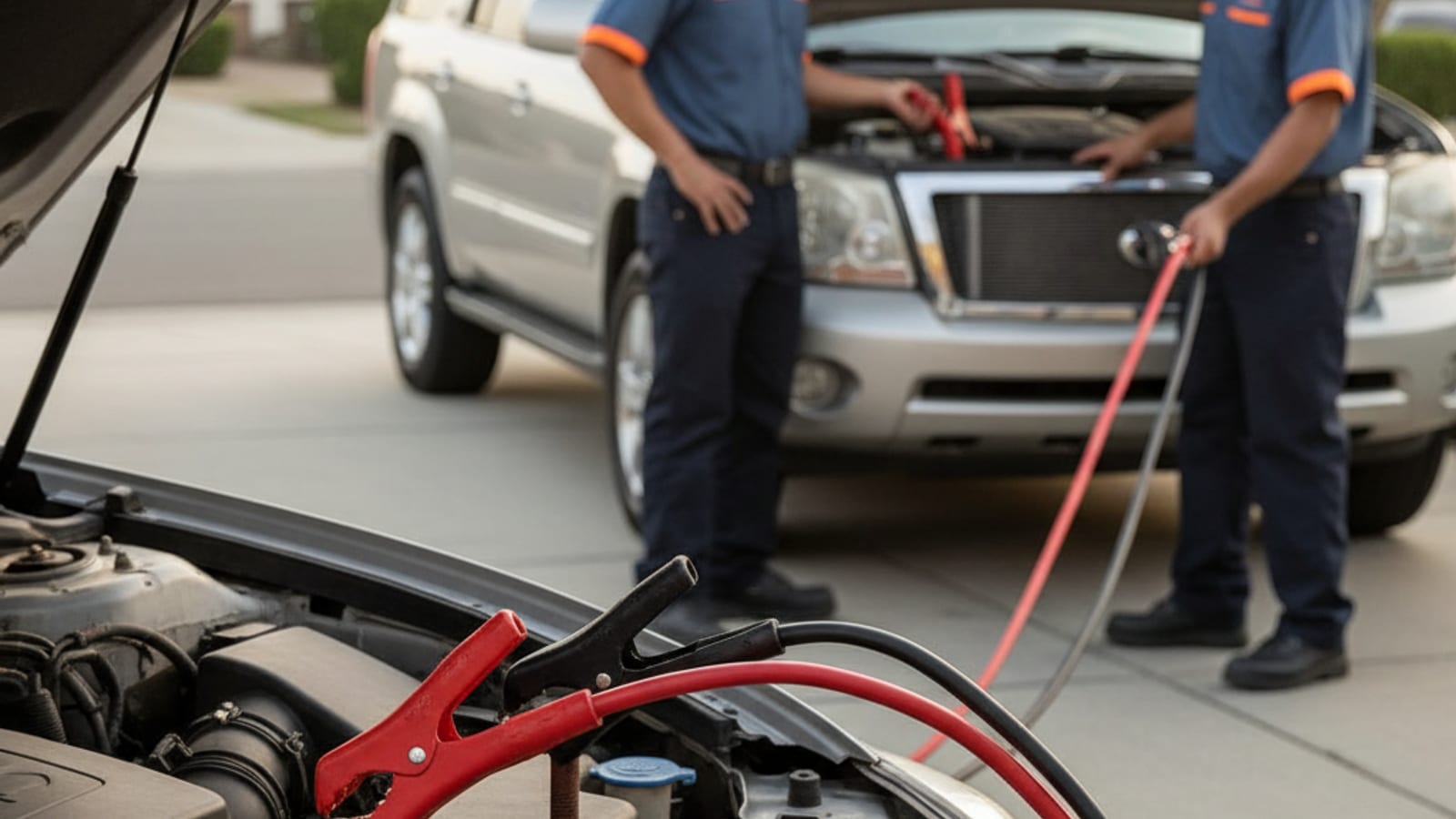
Jump-start a dead battery safely
Jumper cables are simple until you hook them wrong. Do it right and you'll avoid sparks, ruined electronics, and a tow you didn't need.
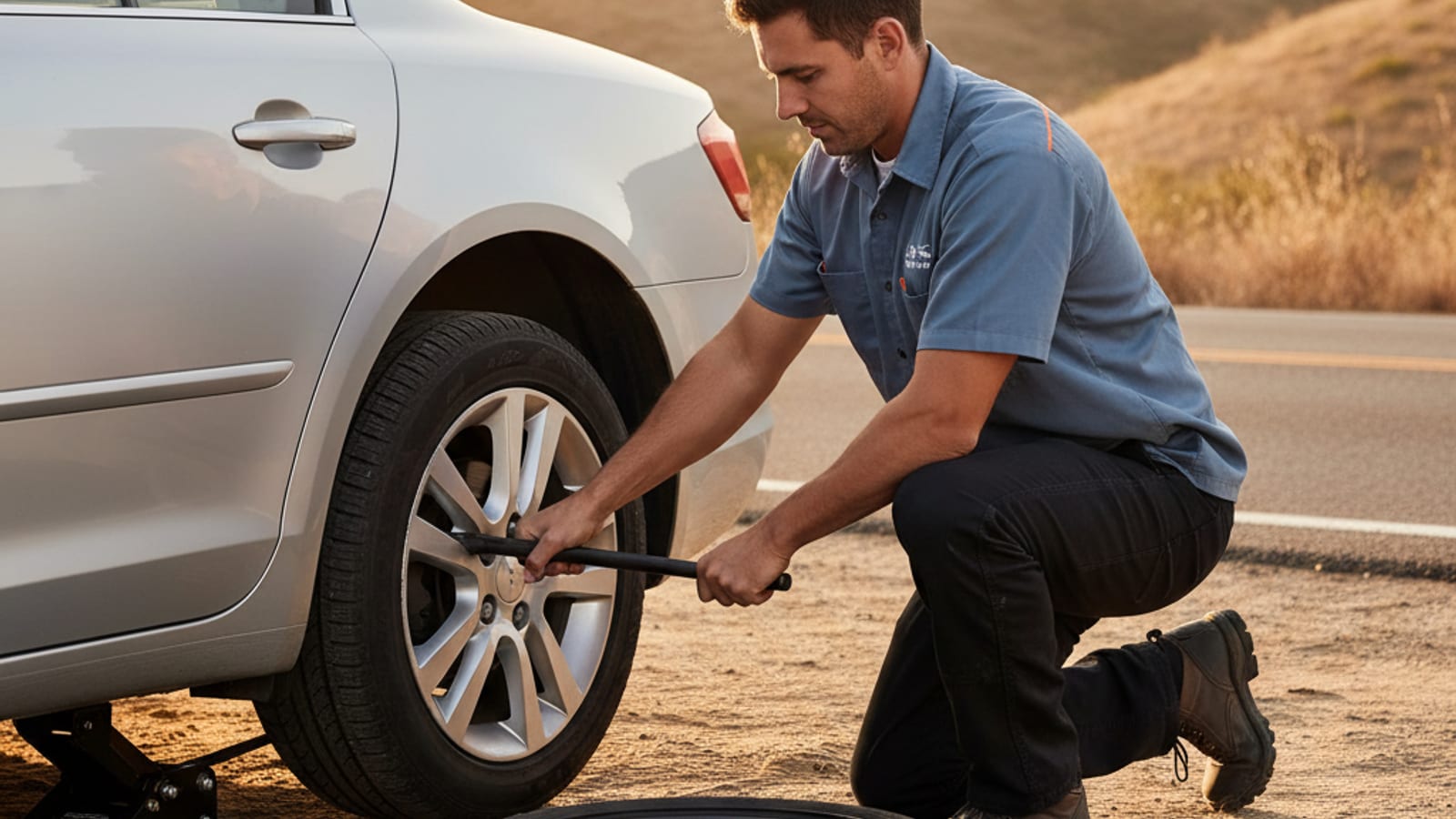
Change a flat tire on the side of the road
The difference between a 20-minute shoulder stop and an hour on the phone with a tow company is knowing where the spare and jack live before you need them.
Flooded wash or dust storm in Phoenix
Monsoon season turns a dry Phoenix wash into moving water in minutes, and a haboob can drop visibility to zero before you can react. First step: stop making it worse.