Flooded wash or dust storm in Phoenix
Monsoon season turns a dry Phoenix wash into moving water in minutes, and a haboob can drop visibility to zero before you can react. First step: stop making it worse.
What you'll learn
- Why it takes only about a foot of moving water to float most cars
- Why you should never try to restart a car that stalled in standing water
- What Arizona's "Stupid Motorist Law" can cost you at a barricaded wash
- Why a haboob calls for pulling fully off the road with all lights off
- When to stop trying and call a winch-out
Step by step
- Never drive into water of unknown depth. NWS guidance is Turn Around, Don't Drown: about a foot of moving water floats many cars, and two feet carries off most SUVs.
- If a wash crossing is barricaded, do not go around it. Under Arizona's Stupid Motorist Law you can be billed for the rescue.
- If the car stalled in standing water, do not try to restart it. Cranking a flooded engine can cause catastrophic damage.
- In a dust storm, follow ADOT's Pull Aside, Stay Alive: pull fully off the roadway, stop, turn OFF all your lights, and keep your seatbelt on so a following driver does not track your tail-lights into you.
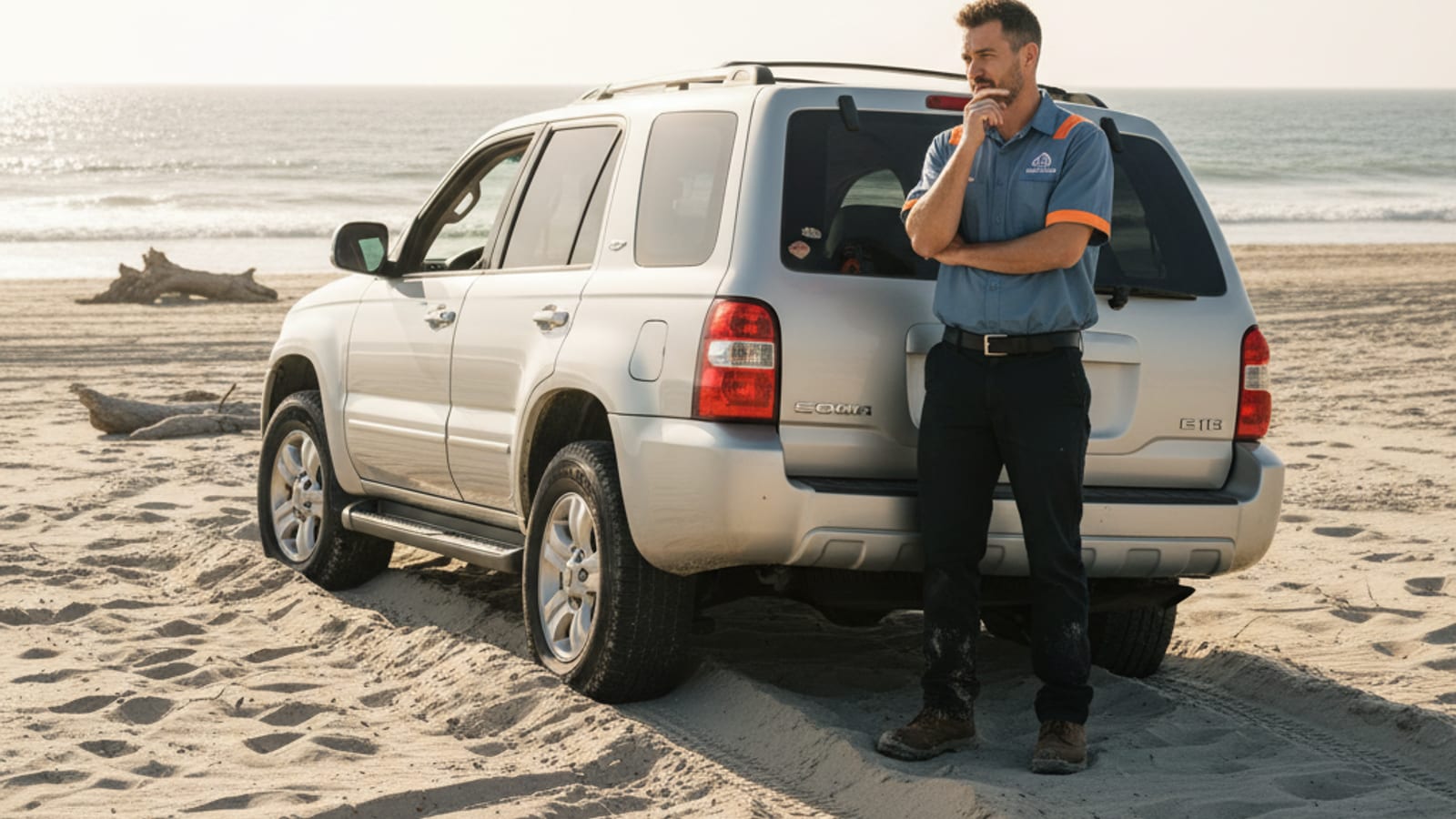
- If you are stuck in soft sand or a wash bank, stop spinning the wheels. Every few seconds of spin digs you in further.
- If it does not move after two careful tries, stop. Call for a winch-out.
The numbers behind a Phoenix monsoon are the reason this comes up every summer. Flash floods are the top thunderstorm killer in Arizona and most flood deaths happen in vehicles. Arizona's Stupid Motorist Law, ARS 28-910, makes a driver who goes around a barricade into a flooded roadway liable for the emergency response, capped at $2,000, and a hydrolocked engine costs far more than that. A winch-out is cheaper than either. Ask whether the assigned operator has recovery gear or a winch for that job.
Why Phoenix floods where it looks dry
Most of the year a wash is a dry sand channel you would not think twice about. During the monsoon, roughly June 15 through September 30, a storm miles away can send a wall of water down that channel while the sky above you is clear. The water moves fast and it is deeper than it looks from a driver's seat. The National Weather Service puts the danger plainly: it takes only about one foot of moving water to float many cars, and about two feet to carry off most vehicles, SUVs included.
Turn Around, Don't Drown, and don't test it
You cannot judge the depth or the current of moving water from behind the wheel, so the only safe rule is to not enter it. If a low crossing or a wash is barricaded, that barricade is there because the road is flooded. Going around it is both dangerous and expensive: Arizona's Stupid Motorist Law, ARS 28-910, makes a driver who drives past a flood barricade liable for the cost of the emergency response, up to $2,000 for a single incident. A tow to a dry route costs a fraction of that.
Never restart a car that stalled in standing water
If your engine died while you were in water, do not turn the key again. An engine draws air in through the intake, and if the intake is below the waterline, cranking the starter pulls water into a cylinder instead of air. Water does not compress the way an air-fuel mixture does, so when the piston comes up to compress it, something has to give, usually a bent connecting rod or a cracked block. That single extra crank is often the difference between a car that needs a tow and a car that needs a new engine.
Haboobs: Pull Aside, Stay Alive
A haboob is a wall of blowing dust that can drop visibility to near zero in seconds. ADOT's official guidance is Pull Aside, Stay Alive, and the core line is simple: if you can't see into it, don't drive into it. When one hits, pull as far off the roadway as you safely can, come to a stop, and turn OFF all your lights, including your tail-lights. Drivers behind you tend to steer toward the last tail-lights they can see, so a lit, stopped car on the shoulder invites a rear-end collision. Keep your seatbelt on and wait for it to pass.
Flood assessment or a normal tow? What decides it
How high the water got is what matters, not how deep it looked from the driver's seat. If water reached the door sills, the floorboards or higher, treat this as a flood-damage assessment rather than a routine breakdown: get the vehicle to a shop or your insurer's preferred facility for inspection before anyone tries to start it, and let them check the engine, transmission fluid and electrical system before you spend a dollar on repairs. If the water only came up around the tires and the engine never took a breath of it, this is usually a normal stuck-vehicle recovery and tow.
Why a flood-affected vehicle goes on a flatbed
A vehicle that sat in moving water, even briefly, may have compromised brakes, a soaked electrical harness, or debris packed into the drivetrain. Ask the assigned operator to quote a flatbed for a flood or wash recovery rather than a wheel lift, so nothing drags, nothing spins, and nothing is asked of a drivetrain that might already be damaged.
Rather have a pro handle it?
Towing and roadside service across the Phoenix metro. One local line, taking calls day and night.
Keep learning.
Jump-start a dead battery safely
Jumper cables are simple until you hook them wrong. Do it right and you'll avoid sparks, ruined electronics, and a tow you didn't need.
Change a flat tire on the side of the road
The difference between a 20-minute shoulder stop and an hour on the phone with a tow company is knowing where the spare and jack live before you need them.
Prepare your vehicle for a tow
A few minutes of prep before the tow truck arrives saves time, avoids damage, and makes the whole call go faster.